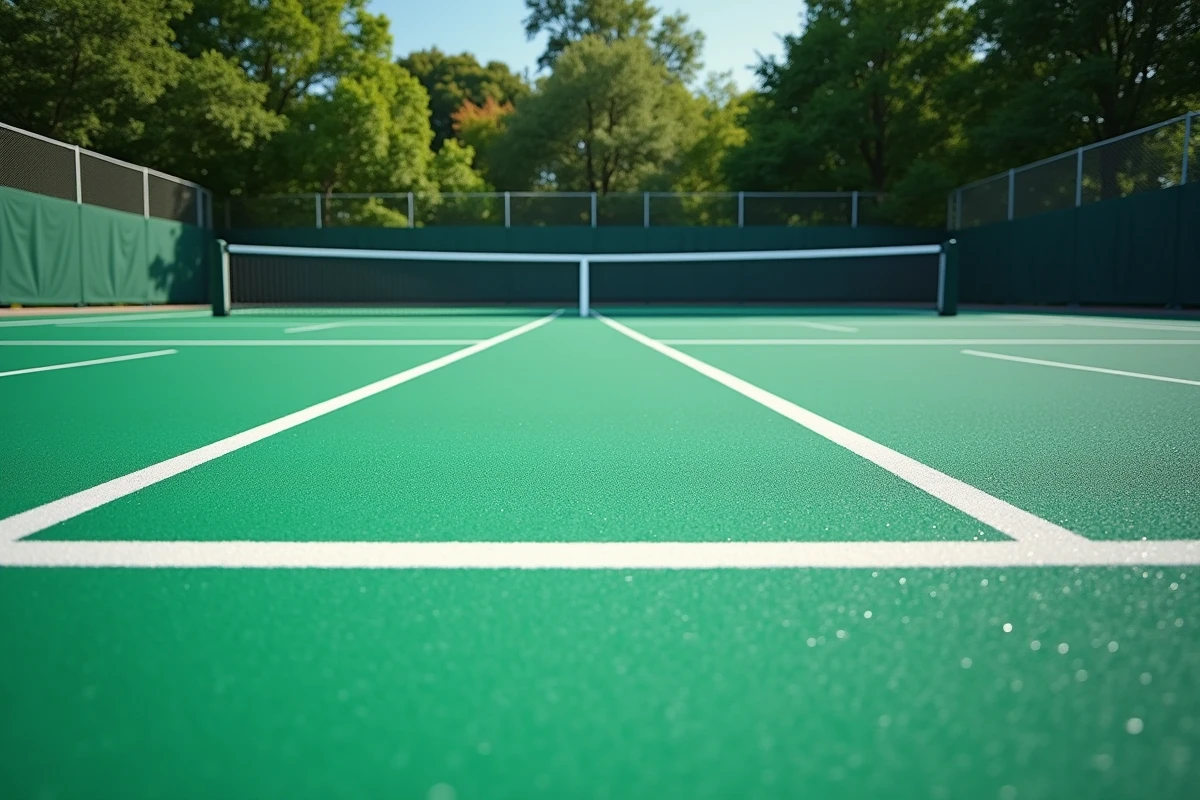
A standard tennis court measures 23.77 m long by 10.97 m wide for doubles play, plus several meters of regulatory setbacks behind each baseline and on the sides. The actual ground footprint therefore far exceeds the playing surface, which influences the entire project: land feasibility, type of surface, and overall budget.
Building, renovating, or converting a court: land use first
The first question to address is not the choice of surface, but the use of the available land. On a constrained plot, building a new court requires a minimum footprint of about 36 m by 18 m (court + setbacks + fences). When this area does not exist or is too costly to free up, two alternatives deserve comparison.
Renovating an existing court generally involves resurfacing and correcting any flatness issues, without touching the foundations or drainage if they are still functional. Renovation preserves the structural work and reduces construction time, but it requires a prior structural assessment: cracks in the support, porosity of the drainage system, condition of the peripheral drains.
Partially converting a court for another sports use, such as padel, is an avenue that industry players are increasingly exploring. A tennis court can accommodate two padel courts side by side, which changes the economic model of a club or community without sacrificing the entire existing infrastructure.
Knowing everything about tennis court construction helps assess whether the existing support can handle this transformation or if starting from scratch is necessary.
Soil study and drainage: the underestimated technical phase
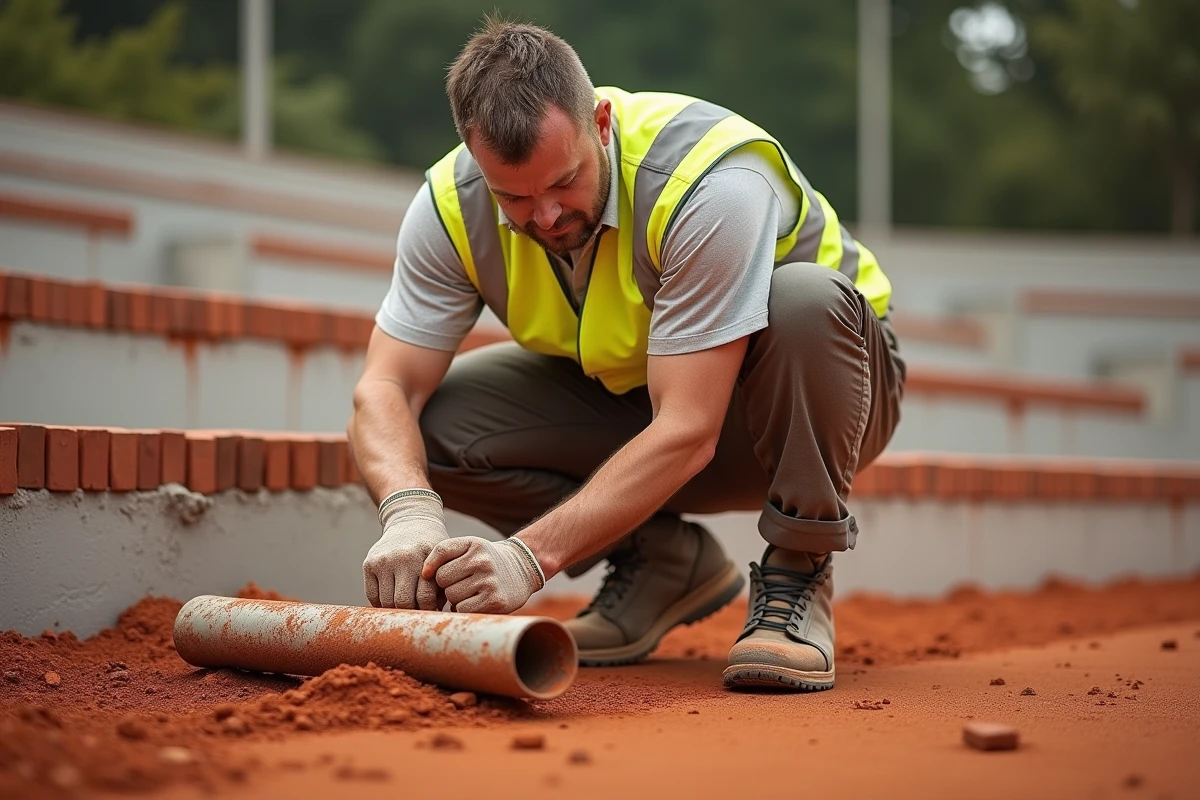
The construction of a tennis court falls under civil engineering, not landscaping. The geotechnical study determines the soil bearing capacity, the depth of the water table, and the nature of the subsoil (clay, fill, rock). This data dictates the thickness of the supporting structure and the type of drainage to install.
A failing drainage system is the primary cause of premature deterioration of a court. Standing water deforms the slab, cracks the surface, and makes the court unplayable after each rain event. The classic system combines a slight cross slope with a network of buried drains that evacuate water to an outlet.
On clay soil, the risk of swelling-shrinkage requires deeper foundations and a thicker layer of graded gravel. This additional cost, often overlooked in initial estimates, can represent a significant portion of the total budget.
Administrative permits
An outdoor tennis court generally requires a prior declaration of work to the town hall. Local urban planning regulations (PLU) may impose height constraints for fences, landscape integration, or distance from property boundaries. Checking the PLU before ordering materials avoids costly modifications during construction.
Court surface: resin, synthetic grass, or porous surface
The choice of surface determines the style of play, maintenance frequency, and lifespan of the court. Three main families stand out for their technical characteristics.
- Acrylic resin: hard surface, fast and consistent bounce, maintenance limited to cleaning and repainting every few years. Suitable for players who prioritize ball speed.
- Synthetic grass: short or medium fibers, filled with sand, offering superior joint comfort compared to hard surfaces. The quality of the synthetic fiber and the density of the filling directly influence longevity and ball behavior.
- Porous surface (such as synthetic clay): replicates the slow play of traditional clay with less demanding maintenance. The surface allows water to pass through, reducing game stoppages in wet weather, provided the underlying drainage is properly sized.
Each surface has its climatic constraints. Resin does not withstand repeated freeze-thaw cycles well if the slab is not perfectly flat. Synthetic grass can overheat in the summer sun. The porous surface requires regular brushing to maintain its grain size.
Maintenance and durability: a court is managed like an infrastructure
Recent specialized content emphasizes a point that general public guides overlook: the play quality of a court depends as much on its use as on its construction. An unmaintained resin surface loses its grip in just a few seasons. A synthetic grass that is never brushed compacts and alters the bounce.
The minimal maintenance program varies according to the type of surface:
- Resin: high-pressure cleaning once or twice a year, repainting of markings as needed, checking for cracks after winter.
- Synthetic grass: regular brushing to straighten fibers, adding filling sand if necessary, checking peripheral drainage.
- Porous surface: watering to maintain playing moisture, leveling the surface material, anti-moss treatment in shaded areas.
The training of those responsible for maintenance (court keepers in an associative or municipal context) is a factor of durability often underestimated. A well-built court but poorly maintained deteriorates faster than an average court that is rigorously monitored.
The lifespan of a surface therefore depends as much on the annual maintenance budget as on the initial investment. Integrating this recurring cost from the project phase allows for clearer decision-making between a cheaper surface to install but high in maintenance, and a more expensive surface to install but almost self-sufficient in the long term.