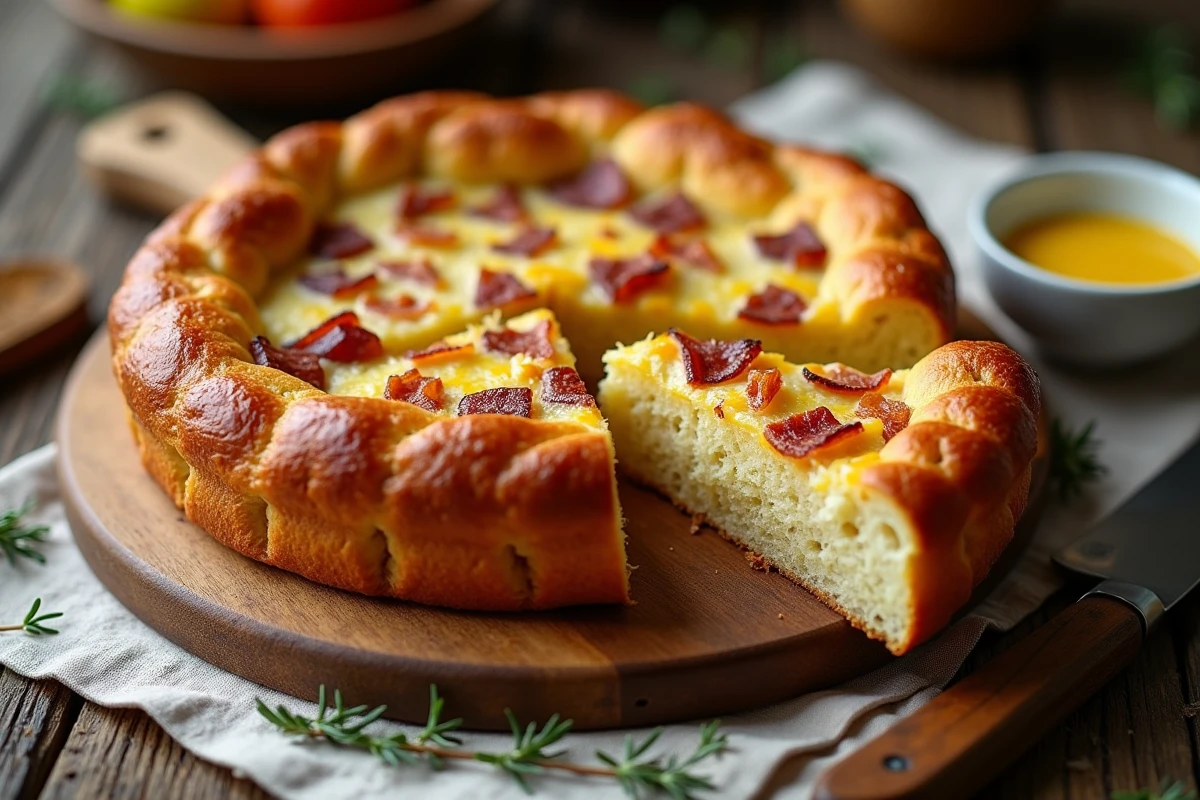
The bacon and Gruyère cake relies on a precise balance of fat, hydration, and dairy proteins. When the crumb collapses or the center remains wet, the problem rarely lies with the oven: it is usually in the batter itself, in the choice of bacon, or in the type of grated cheese used.
Kefir or Greek yogurt in savory cake batter: why change the liquid
Most savory cake recipes use whole milk or liquid cream as a hydration base. Replacing part of this milk with kefir or Greek yogurt significantly alters the texture.
The natural acidity of fermented dairy products softens the gluten network formed by the flour. The crumb becomes more flexible without becoming sticky. This acidity also reacts with baking powder, improving the rise during baking and resulting in a lighter cake.
Another advantage is preservation. A bacon and Gruyère cake made with Greek yogurt stays moist longer than a classic milk cake because the proteins in yogurt retain more water in the crumb. For an appetizer planned for the next day, this is a real benefit. Those looking for easy recipes on Trop Facile will find this hydration principle applied to several savory cake variations.
In practice, the measurement remains simple: for the total liquid amount in the recipe, replace half with thick Greek yogurt. The rest can be milk or even olive oil, depending on the desired richness.
Choosing the bacon: what changes in the cake’s crumb
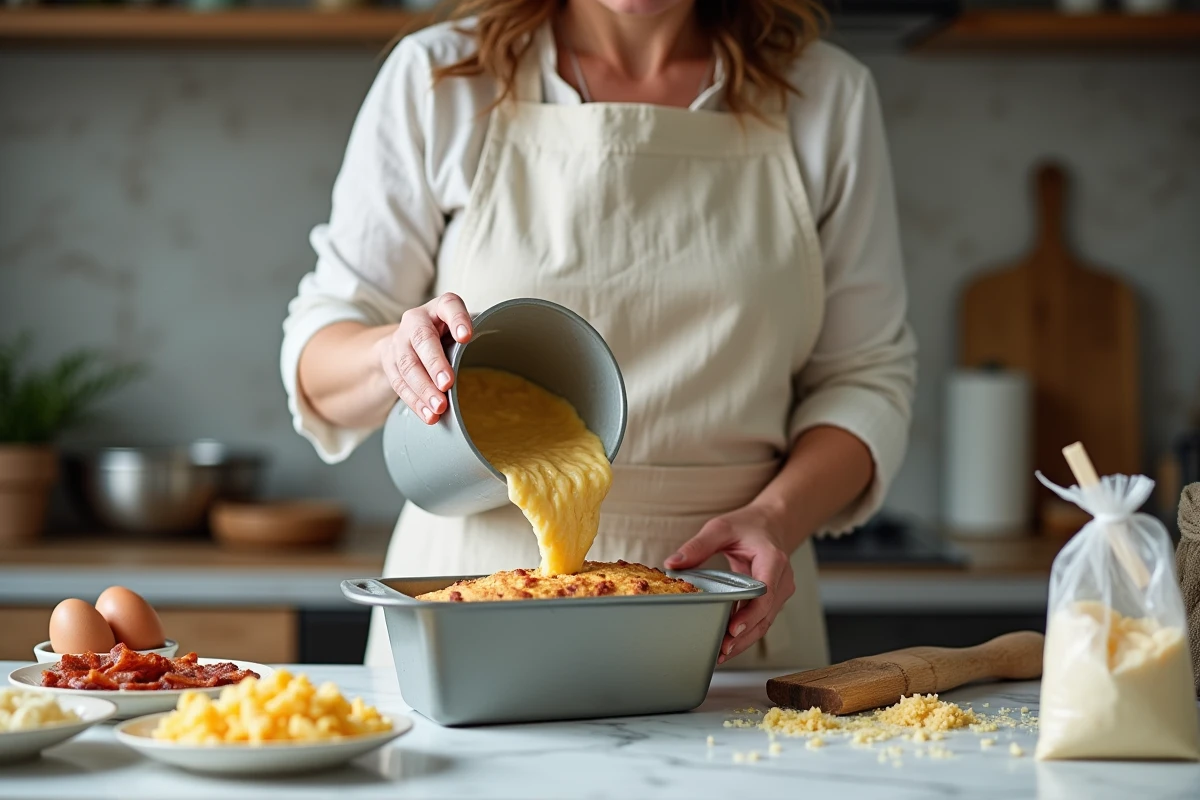
Not all bacon behaves the same way during cooking. Standard bacon releases a significant amount of water and fat into the batter. This excess liquid causes greasy pockets in the crumb and can compress the cake in the center.
Comparative tests conducted by the magazine 60 Millions de consommateurs on bacon (special charcuterie issue, February 2024) show that premium bacon releases less water and fat during cooking. The result in a savory cake is direct: fewer greasy holes, a more homogeneous crumb, and a cake that holds together better when cut.
Beyond the choice of product, a step often overlooked makes a difference. Sautéing the bacon dry in a pan before incorporating it into the batter helps to remove excess fat. Drain it on paper towels, then let it cool before mixing it into the batter. Adding hot bacon to raw batter begins to cook the flour in spots, creating uneven areas.
Smoked or plain bacon in a cake
Smoked bacon adds a more pronounced aromatic note that pairs well with Gruyère. Plain bacon leaves more room for other ingredients if the recipe includes olives, mustard, or herbs. The choice is a matter of taste, not texture.
Young or aged Gruyère: aging changes the cake’s texture
The National Interprofessional Center for Dairy Economy (CNIEL) specifies in its technical guide “Cheeses and Culinary Applications” (2023 edition) that young Gruyères or Comtés melt more uniformly and shrink less when cooling than more aged versions.
For a bacon and Gruyère cake, this difference has a concrete impact. A short-aged grated cheese distributes better in the batter during baking. When cooling, it does not harden as much as an aged Gruyère, which keeps the crumb soft even after several hours.
An extensively aged Gruyère has more flavor character, but it forms stiffer strands in the crumb once the cake is warm. The ideal compromise for an appetizer: mix two-thirds of young grated Gruyère with one-third of more aged Comté. The texture remains moist, and the flavor gains depth.
Preparing the batter: order of incorporation and baking
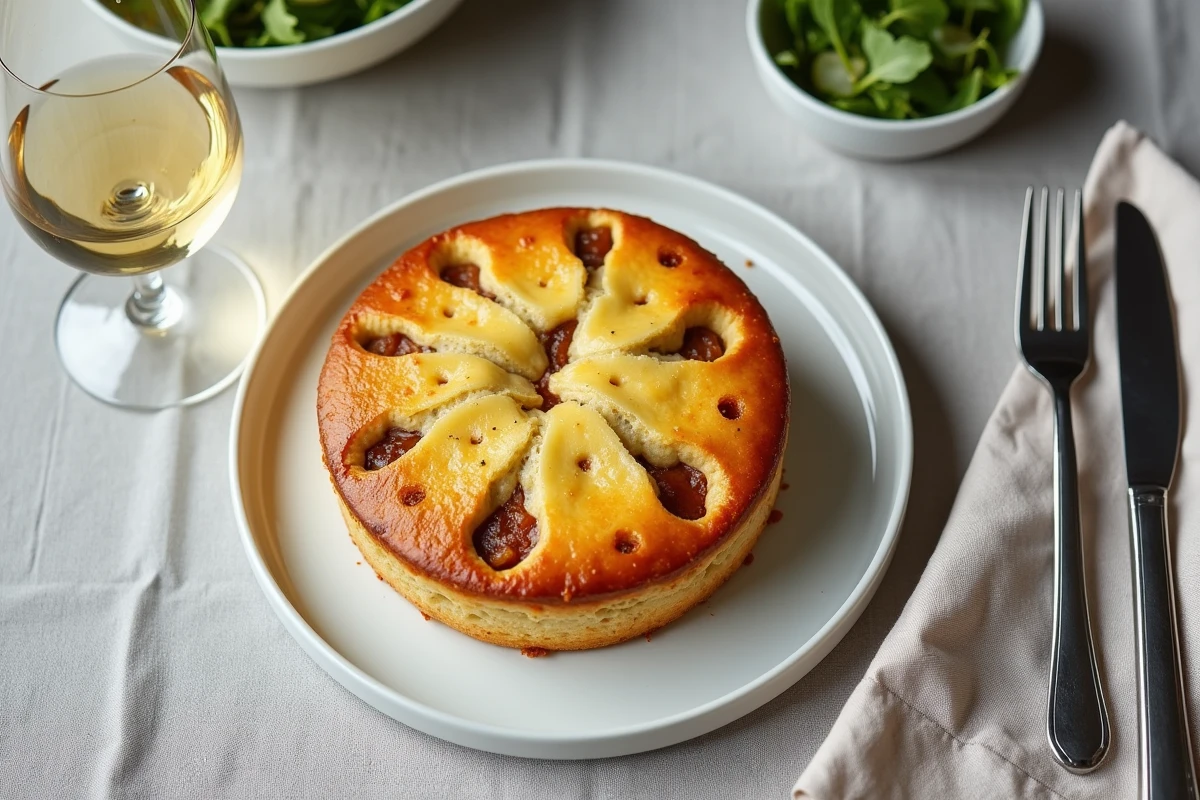
The order in which the ingredients are mixed determines the final structure of the cake. First, mix the eggs with the oil (or warm melted butter) and Greek yogurt until you achieve a smooth batter. Then add the sifted flour with the baking powder all at once, and mix just enough for the flour to disappear.
- The flour should never be worked for too long: excessive mixing develops gluten and results in an elastic cake instead of a tender crumb
- The grated cheese is incorporated last, along with the cooled bacon, using gentle spatula movements to avoid knocking the air out of the batter
- The baking powder acts as soon as it comes into contact with the acidic liquid from the yogurt, which requires baking quickly after mixing
For baking, a classic loaf pan works better than a flexible silicone mold. Metal transmits heat more evenly. Greasing and flouring the pan is more reliable than parchment paper alone, which can stick to the sides of the savory cake due to the fat from the bacon.
Baking temperature and duration
A bacon and Gruyère cake bakes at moderate heat. The batter should rise gradually without forming a thick crust too early, which would prevent the center from cooking. The knife blade test remains the most reliable method: if it comes out dry, the cake is ready.
- Let the cake rest in its pan for about ten minutes before unmolding, so the structure stabilizes
- Cut it only once it is warm, never hot, to avoid crushing the still fragile crumb
- Store under plastic wrap at room temperature for an appetizer in the following hours, or in the refrigerator for the next day
A well-hydrated bacon and Gruyère cake, made with lean bacon and a short-aged cheese, retains its moist texture well beyond coming out of the oven. The detail that makes a difference is the choice of liquid in the batter: Greek yogurt transforms a decent cake into a memorable one.