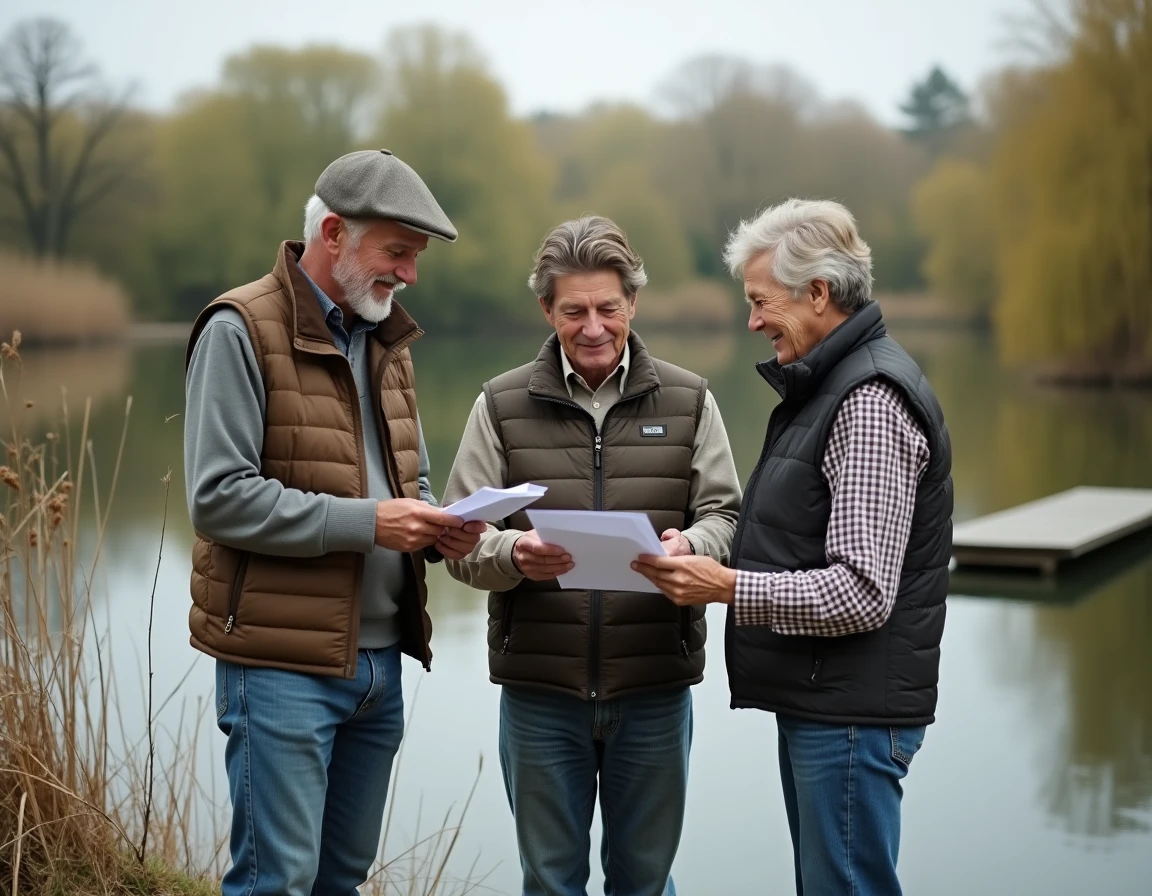
Buying a pond together requires transforming a recreational project into a structured legal arrangement. The co-ownership of a body of water does not fall under the classic regime of built properties: it most often relies on a co-ownership agreement or the creation of a real estate civil company, two frameworks with very different implications regarding management, taxation, and environmental responsibility.
Ecological continuity and shared obligations on a jointly owned pond

Restoration policies for the ecological continuity of waterways now also affect small private ponds. Requests for the removal or modification of structures (dikes, weirs, gates) can target a property held by multiple owners, complicating decision-making.
When a pond is in joint ownership, each co-owner must give their consent for works affecting the substance of the property. A single refusal can block compliance, exposing all co-owners to administrative sanctions.
Before signing, it is essential to check the hydraulic status of the body of water (closed water or free water) and consult the local water authority. A pond classified as free water imposes much heavier fishing and maintenance constraints than a closed water pond, where the owner retains control over the fish population.
For those wishing to buy a pond with H Immobilier, this verification of hydraulic status is part of the points analyzed in advance of the collective arrangement.
SCI or joint ownership: which legal structure for a pond purchased together

Joint ownership is the default regime when several people buy a property together without creating a structure. Its simplicity is misleading: Article 815 of the Civil Code allows any co-owner to initiate a division at any time, which can force the sale of the pond.
The SCI offers a more stable framework. Shares replace undivided shares, and the statutes define the rules of majority, transfer, and withdrawal. The SCI prevents a partner from forcing the sale of the body of water as long as the company exists.
Here are some criteria to decide between the two options:
- Number of buyers: beyond three or four people, the SCI becomes almost essential to avoid decision-making blockages.
- Transmission project: the SCI facilitates the donation of shares to children, with a renewable tax allowance, which joint ownership does not allow as easily.
- Formation costs: an SCI incurs fees for drafting statutes, legal publication, and annual accounting, whereas conventional joint ownership is limited to a notarized deed.
- Duration of the project: for a purchase among friends over ten or fifteen years, the SCI better secures each person’s exit through approval clauses.
The choice of structure also affects taxation. In an SCI subject to income tax, each partner declares their share of potential rental income. In joint ownership, the tax treatment remains the same, but the administrative management relies on a single representative, often poorly identified.
Usage regulations for a jointly owned pond: limiting conflicts between owners
The usage regulation (or usage agreement) is the most underestimated document in a collective pond purchase. Without it, each co-owner theoretically has equal usage rights, which generates friction as soon as projects diverge.
A co-owner cannot turn the pond into a commercial activity without collective agreement. Court decisions remind us that paid fishing, workshops, or event rentals can be prohibited if the regulation or the property’s destination does not provide for them.
The regulation must cover at least three frequent areas of friction:
- The occupancy schedule: who uses the pond and its surroundings during which period, according to what rotation system.
- Authorized and prohibited uses: recreational fishing, swimming, introduction of species, installation of docks, temporary accommodation (cabin, tent, camper).
- The distribution of maintenance costs: dredging, harvesting, dike repair, civil liability insurance, property tax.
This document should be drafted with a notary or a lawyer specialized in rural law. Having it signed before the sale, rather than after, avoids tense renegotiations.
Actual budget of a shared pond: recurring charges and overlooked items
The acquisition price represents only a fraction of the total cost. Notary fees on a pond are close to the rate applicable to undeveloped land, significantly higher than for an older home.
Recurring charges are often underestimated by collective buyers. Maintaining a body of water requires periodic dredging, the frequency of which depends on siltation and surface area. The harvesting of banks, management of invasive species, and regulatory draining represent significant items.
Insurance is another item not to be overlooked. A pond exposes its owners to civil liability in case of drowning, pollution, or dike failure. Each co-owner must ensure that the contract covers all co-owners or partners.
Finally, property tax varies significantly depending on municipalities and the cadastral classification of the land. Some wetlands benefit from partial exemptions, while others do not. It is better to ask the seller or the land tax office for the exact amount before signing.
A successful joint pond purchase occurs when the legal framework, usage regulation, and budget forecast are finalized before the sales deed. The most solid arrangement is one where each participant knows their rights, obligations, and exit strategy.