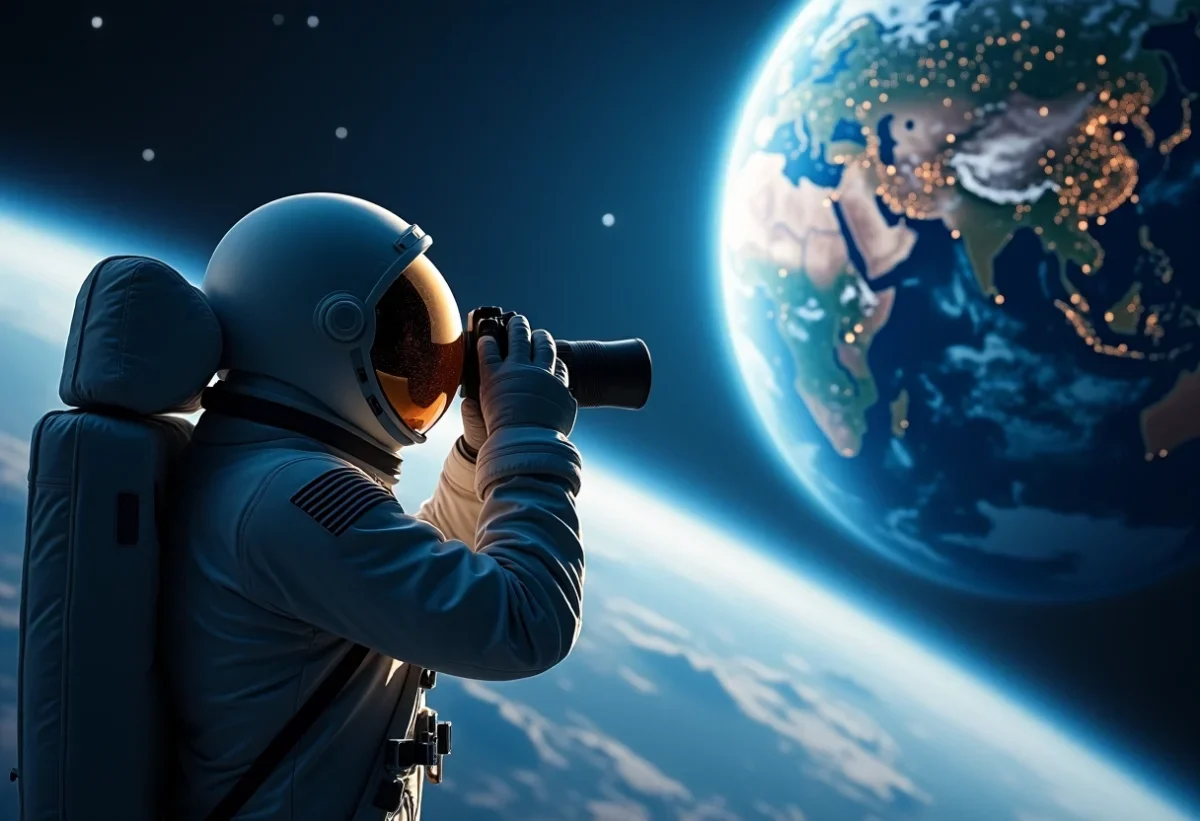
Space photography, which captivates the collective imagination, is much more than a simple image capture. Behind each shot lies cutting-edge technology and meticulous planning. Telescopes and space probes, such as Hubble or James Webb, traverse unimaginable distances to immortalize distant galaxies, colorful nebulae, or mysterious black holes.
Each image requires international collaboration and decades of research. Engineers and scientists work in tandem to calibrate instruments, adjust angles, and process the collected data. The magic happens when these raw pixels transform into true works of art, revealing the wonders of the universe.
Advanced Techniques in Space Imaging
Collaborations between international space agencies, such as NASA, the European Space Agency (ESA), and the Canadian Space Agency (CSA), are at the heart of innovation in space imaging. These partnerships allow for the sharing of resources, knowledge, and technologies to push the boundaries of our understanding of the universe.
The James Webb Space Telescope, a product of this collaboration, has already captured stunning images such as SMACS 0723, a galaxy cluster 4.6 billion years old, and the Southern Ring Nebula, located about 2000 light-years from Earth. These shots are not only spectacular; they provide valuable data to astrophysicists around the world.
- SMACS 0723: galaxy cluster as it appeared 4.6 billion years ago.
- Southern Ring Nebula: planetary nebula located about 2000 light-years from Earth.
- Stephan’s Quintet: the first compact group of galaxies ever discovered.
The Euclid Space Telescope, designed by the ESA to uncover the mysteries of dark matter and dark energy, has also captured cosmic wonders such as the Horsehead Nebula and the Perseus Cluster. The precision with which these images are taken reveals details of unparalleled accuracy.
For astronomy enthusiasts, the photo of the moon on Pix is a perfect illustration of the technical expertise required to obtain images of exceptional clarity and sharpness. Every pixel counts, and every decision made by the scientific teams directly impacts the quality of the collected data.
These advanced techniques are the result of decades of research and development. The Space Telescope Science Institute plays a fundamental role in coordinating the operations of the James Webb telescope, ensuring that each mission is optimized to obtain the best possible images. 
The Mysteries Revealed by Space Images
The images captured by space telescopes, such as James Webb and Euclid, reveal fascinating cosmic secrets. Among these discoveries, the Carina Nebula, discovered by Nicolas-Louis de Lacaille in 1752, is one of the brightest nebulae in the sky. This nebula, also known as NGC 3372, contains star-forming regions such as NGC 3324.
- Carina Nebula: also called NGC 3372.
- NGC 3324: star-forming region within the Carina Nebula.
The Stephan’s Quintet, discovered by Edouard Stephan, is another compact group of galaxies that intrigues astrophysicists. This group, which includes NGC 7319, is studied to understand gravitational interactions between galaxies.
| Object | Description |
|---|---|
| Stephan’s Quintet | First compact group of galaxies ever discovered |
| NGC 7319 | Barred spiral galaxy, member of Stephan’s Quintet |
The data collected by the Euclid telescope also provides valuable insights into structures such as the Perseus Cluster, a massive structure located 240 million light-years from Earth. This cluster is studied to learn more about the dark matter that makes up a large part of our universe.
The James Webb telescope, for its part, has captured images of WASP-96b, a gas giant located nearly 1150 light-years from Earth, and The Brick, a very dark and dense rectangular area of the Milky Way. These observations allow for the exploration of stellar formation processes and galactic evolution.
The mysteries revealed by these space images continue to amaze the scientific community, opening new perspectives on our understanding of the universe.