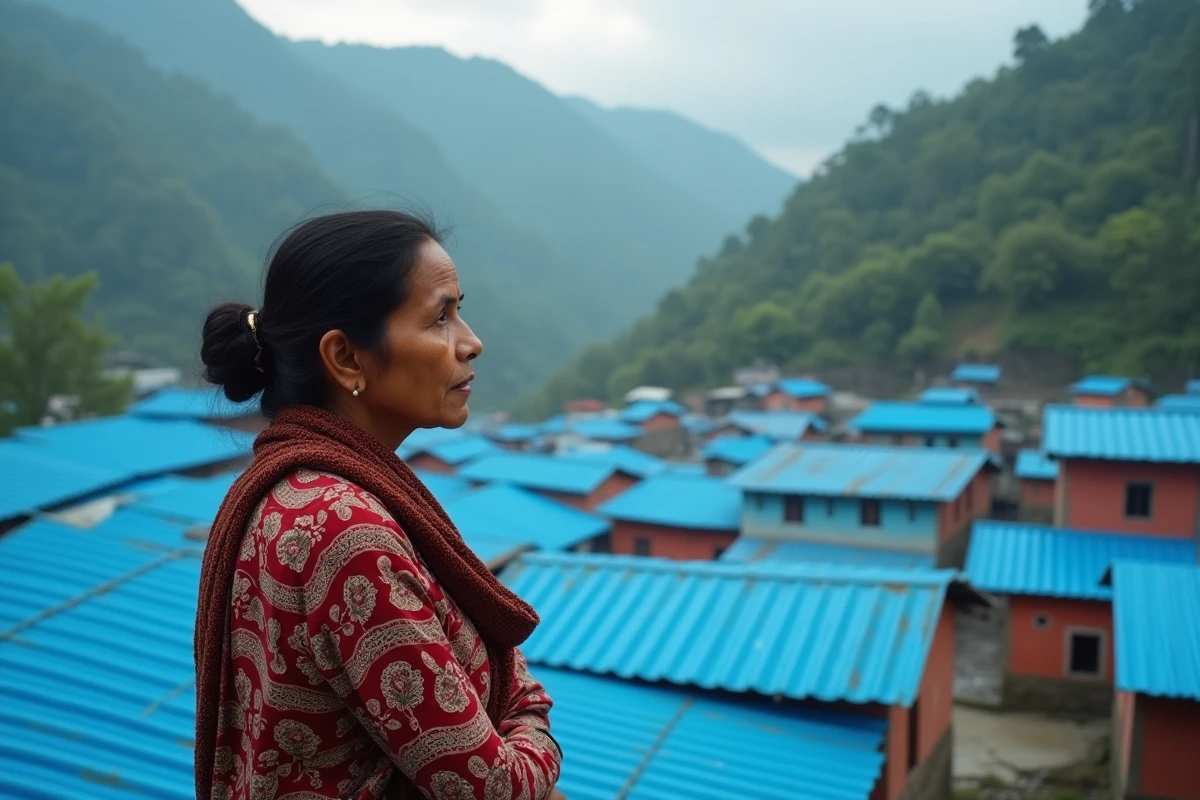
A blue roof appears around a bend in a path, shining under the white light of the Himalayan morning. In Nepal, the blue color of roofs is neither a coincidence nor a mere architectural trend. This unique shade responds to practical choices, religious influences, and a history marked by regional exchanges.
The massive adoption of blue in certain areas contrasts with other parts of the country, where traditions differ significantly. This phenomenon, far from being uniform, reveals a plurality of uses, beliefs, and technical constraints. The reasons for this predominance thus go beyond mere aesthetics and are part of a complex dynamic, blending necessity, spirituality, and local identity.
The blue roofs of Nepal, a visual signature between sky and mountain
In the Kathmandu Valley, blue displays itself on the roofs like a discreet signal, easily spotted from the hills surrounding the city. Kathmandu, the political and religious capital of Nepal, unfolds its compact neighborhoods around Durbar Square, the historic center where the Taleju temple, built in 1564, stands. Here, nothing is left to chance: blue, omnipresent in Bhaktapur, Patan, and even in Pokhara, establishes itself as a visual landmark, almost a banner against the peaks of the Himalayas.
This color isolates the houses against the mineral backdrop of the mountains. Altitude and harsh light sculpt the landscape, making the blue more intense, whether one is in Mustang or in an alley of Patan. The Kathmandu Valley, with 1.5 million inhabitants, concentrates these striking contrasts between innovation and heritage. Around the Swayambhunath stupa, one of the oldest Buddhist sanctuaries, or the Bodnath stupa, the blue roofs converse with the gold and white of the sacred buildings.
Why are roofs blue in Nepal? This question intrigues travelers and architects. This choice goes far beyond a visual effect: it is rooted in customs, the desire to stand out in the city, and a subtle influence from neighboring Tibetan regions, as evidenced by the page ‘Blue roofs: why do the Chinese perpetuate this tradition? – ARTS Constructions’. Blue gradually establishes itself, resonating with beliefs, the light of altitude, and the desire to affirm the home, the family, the hearth, in a country where the verticality of the terrain dictates choices even in the most intimate architecture.
Why this color? Between ancestral traditions and natural influences
Questioning the reasons for blue on Nepalese roofs is to trace back the thread of a collective memory. In the villages of Mustang, Bhaktapur, or Pokhara, this color, far from being a whim, is rooted in a preserved Tibetan culture and in the attention paid to the Himalayan nature. The Sherpa, Gurung, Magar, or Tamang communities, all attached to their rituals, see in blue a protective barrier.
The tradition links this blue to spirituality. Followers of Buddhism, heirs to the teachings of Siddhartha Gautama, consider this shade to represent the sky, wisdom, and inner peace. The blue roofs, which stand out against the ridges, mark the connection between the earthly world and the sky, a form of aspiration to purity, but also a rooting in the Kathmandu Valley or the high plateaus of Mustang.
The influence of the environment is also reflected in the techniques used: in some villages, the local earth, enriched with minerals, produces this deep blue, capable of withstanding humidity and the harshness of high-altitude sun. The light, brighter on the reliefs, makes this color vibrate, to the point that some roofs seem to shine at noon.
But blue is not just for aesthetics. It distinguishes the Nepali house, signals the home, hospitality, and sometimes indicates the presence of a hotel or a lodge where lunch or a meal is shared with travelers. Here is what this color embodies in daily life:
- Symbol of protection and spirituality
- Heritage of Tibetan culture and Himalayan peoples
- Adaptation to natural and climatic constraints
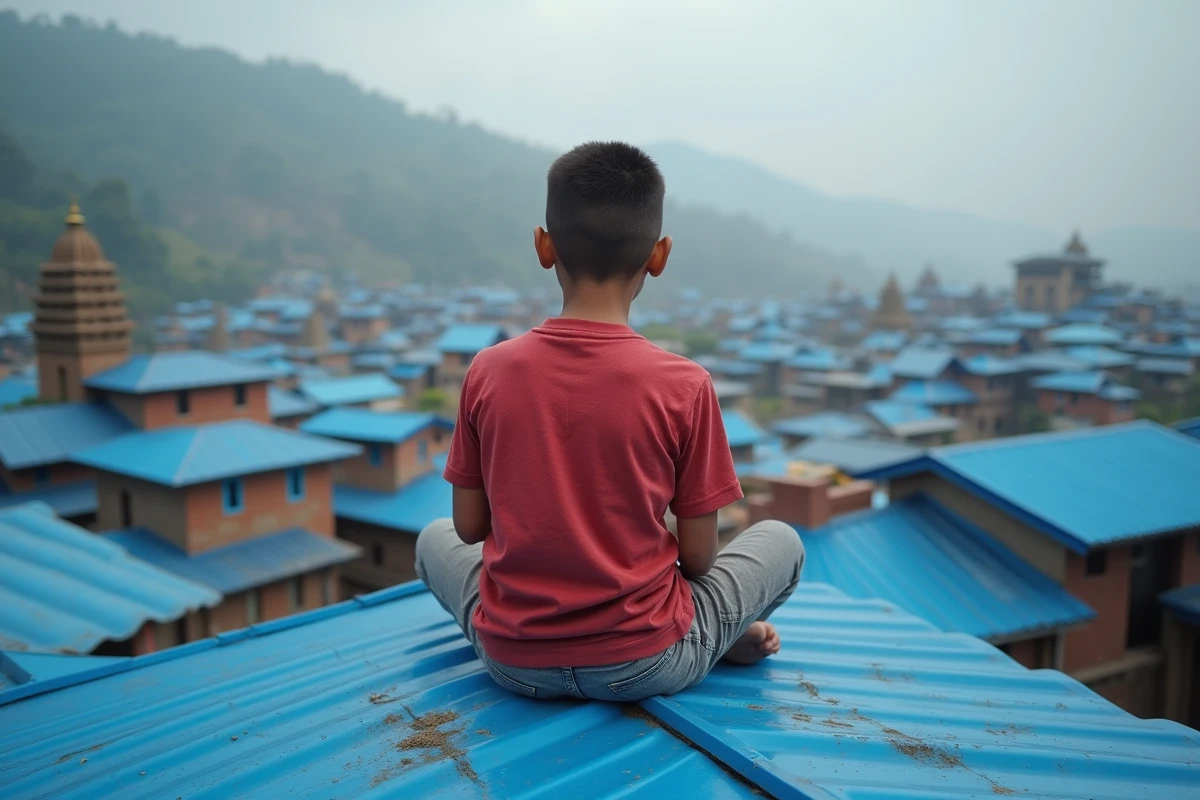
Explore Nepal differently: natural wonders, trekking routes, and crafts not to be missed
Nepal, nestled against the Himalayas, is not limited to the silhouette of Everest that cuts the horizon. Eight peaks over 8,000 meters challenge the thin air, but the country reveals its richness in its valleys, markets, lakes, and the diversity of its peoples.
The trekking routes carve spectacular paths, from the legendary Annapurna Circuit to the preserved region of Mustang. The Kali Gandaki gorge, renowned for its dizzying depth, carves an impressive furrow in the mountain. At each stop, there is a meeting: a lodge where lunch is improvised around a table with guides, families, and trekkers from all over the world.
To the south, the Chitwan National Park, a UNESCO World Heritage site, offers refuge to the last Bengal tigers and the one-horned rhinoceros. Further north, the Langtang National Park is home to the red panda in its rhododendron forests. The high-altitude lakes, Rara, Tilicho, Gokyo, Gosaikunda, impose silence and invite contemplation.
The Nepali artisanal heritage, alive in the markets of Bhaktapur, Patan, or Pokhara, perpetuates the country’s craftsmanship. Sculptures, textiles, jewelry, singing bowls: each piece tells a story. In the Kathmandu Valley, the artisan’s hand connects the past and present, from the stone of a stupa to the fabric of a shawl. The color of the roofs also testifies to this subtle dialogue between necessity, belief, and creativity. Nepal continues to surprise anyone who dares to look up at its blue roofs.